Guangshuo Li, Meixiang Zheng, Xiaotong Zhou, Dalin Xu, Xuejing Cui, Songliang Liu*, Hao Dong*, Luhua Jiang*
1. Electrocatalysis & Nanomaterial Laboratory, College of Materials Science and Engineering, Qingdao University of Science and Technology, Qingdao 266042, P. R. China
2. School of Chemistry and Chemical Engineering, Liaoning Normal University, Dalian 116029, P. R. China
* Corresponding authors:
*E-mail: liusongliang@qust.edu.cn, hdong@lnnu.edu.cn, luhuajiang@qust.edu.cn
Abstract
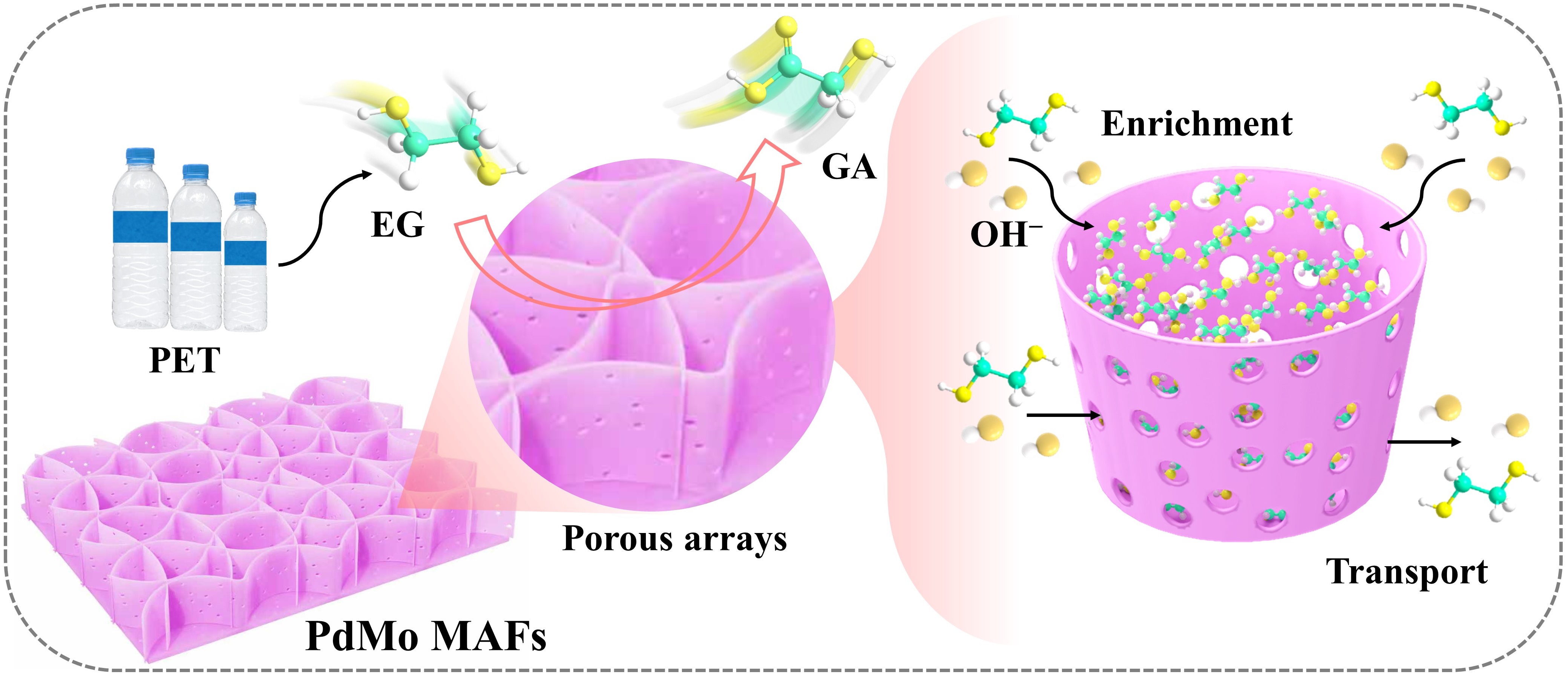
Electrocatalytically upgrading polyethylene terephthalate to glycolic acid (GA) has garnered significant interest in the field of electrosynthesis. However, rational design of electrocatalysts that integrate superior intrinsic activity, selectivity and favorable mass transport tailored to high-current operation remains a formidable challenge. Herein, we report a universal CO-mediated approach to synthesize a class of porous PdM (M = Mo, Mn, Co, Ni, Cu, Pt) metallene array films (MAFs) featuring a well-patterned network and interconnected pores in structure. The as-made PdMo MAFs achieves a very high Faradaic efficiency of 93.8% toward GA with a GA selectivity of 95.7% at 100 mA cm⁻2 and cycling stability of 24 h in a flow electrolyzer, demonstrating competitive performance among the reported Pd-based catalysts. Comprehensive experimental and theoretical investigations reveal that the exceptional catalytic performance of PdM MAFs originates from two synergistic advantages: the incorporation of transition metals and tensile strain induced by the interconnected pores collectively modulate the electronic structure of Pd active sites lowering the energy barrier of the rate-determining step, alongside the prominent reactant-enrichment capability of MAFs derived from its structure-exclusive strengthened interfacial electric field, which ensures adequate reactant supply under high-current operation.
Keywords: Pd alloys, metallene array films, tensile strain, electrosynthesis, waste plastics upcycling.